
The Colonial Question, Part Two
The Land Before the Framework

This is a continuation of the series starting here Israel, The Colonial Question, Part One and is also related to the antisemitism as structure series starting here 1492: One Empire, Two Minorities, Two Logics of Power
The Framework and the Function
The settler colonial framework was developed primarily to describe European overseas empire: populations with no prior connection to the territory they occupied, arriving as agents of expansion from a position of metropolitan security and power, with the active backing of colonizing states. Before asking whether Zionism fits this description, it is worth asking whether the historical record it is being applied to accurately reflects what the framework was built to describe.
It doesn’t. And the mismatch is not incidental, it runs across every structural requirement the framework specifies.
What the Framework Requires
Patrick Wolfe, whose 2006 formulation of settler colonial theory remains the field’s foundational text, specifies that the logic of elimination applies to social groups “constituted prior to and independently of the normative basis on which settler society is established.” The arriving population must be an extension of a metropolitan power, operating with its sponsorship, displacing a native population whose prior constitution is not substantially shaped by the colonial encounter itself.
These are not incidental qualifiers. They are structural requirements. The framework’s entire analytical apparatus, the logic of elimination, the structure rather than event formulation, the decolonization endpoint, depends on them being satisfied. When they are not satisfied, the framework is not describing the case. It is being applied to it regardless.
The Ottoman and pre-Mandate historical record fails to provide these requirements. The failure is worth examining in detail, because each point of failure tells you something specific about what the historical record actually shows.
The 1858 Ottoman Land Law and the Pre-Aliyah Disruption
The most rigorous archival study of the pre-aliyah period in Palestine is Alexander Schölch’s Palestine in Transformation, 1856-1882 (1993), which draws on Ottoman administrative records, consular reports, and European commercial archives to document what was happening to Palestinian land and labor before the first significant wave of Jewish immigration began in 1882.
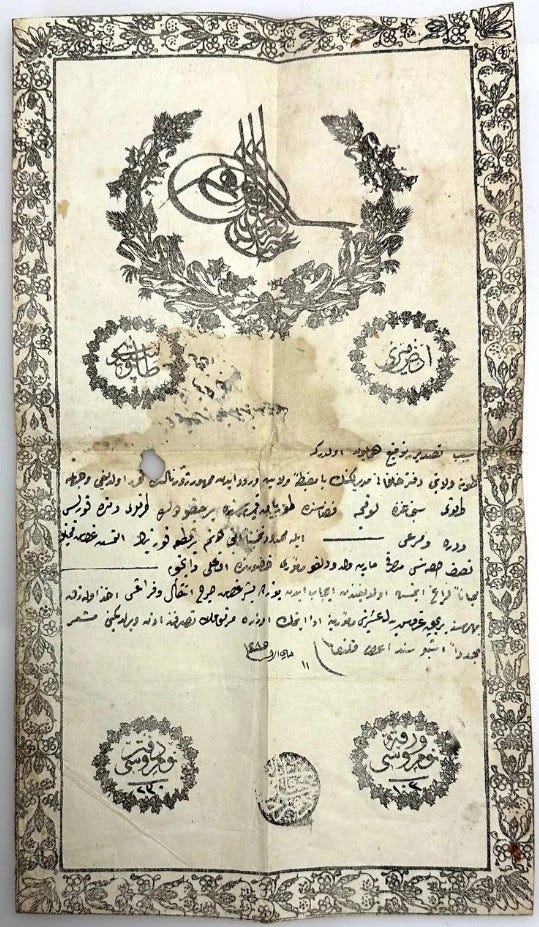
What Schölch establishes is that Palestine was already being substantially transformed by European economic penetration and Ottoman centralization a generation before Zionist buyers arrived. The central mechanism was the 1858 Ottoman Land Law.
Before 1858, Palestinian agriculture operated substantially under the musha’ system, a form of communal rotating tenure in which cultivation rights, effective occupation, and formal ownership were distinct, overlapping categories that did not map onto each other cleanly. A family might cultivate a particular plot for generations without holding formal legal title to it, because under musha’, cultivation rights were communally allocated and periodically redistributed. The system worked within an Ottoman legal culture that recognized multiple overlapping forms of claim on the same land.
The 1858 Law formalized Ottoman land categories through a mandatory registration requirement that, in practice, treated customary cultivation rights as legally inferior to registered title. Schölch is careful to note that the law did not create fundamentally new land-ownership norms but comprehensively codified existing Ottoman law, the goal was fiscal reform, specifically the extension of individual registration to all land holdings. It was part of the broader Tanzimat reform program, and it had a specific consequence for Palestinian cultivators. Formal legal title now required registration with Ottoman authorities. This process required navigating Ottoman bureaucracy, paying registration fees, and demonstrating claims through documentary evidence that most fellahin did not possess and could not easily produce.
The result was systematic. Fellahin who had cultivated land for generations under musha’ frequently did not register their cultivation rights as formal title. Many were unaware of the requirement, unable to navigate the process, or unwilling to pay the fees or risk the tax implications of formal registration. Large landowners, wealthy merchants, and urban effendis, in many cases absentee owners in Beirut, Damascus, or Constantinople, registered formal legal title to land their tenants had farmed for generations without the tenants’ knowledge or consent.
By the time Zionist land purchasers arrived in any significant numbers in the 1880s and 1890s, they encountered a landscape whose formal legal ownership had already been substantially reconstituted by this Ottoman-European interaction. When Jewish buyers purchased land from registered legal title-holders, they were operating downstream of a transformation they had not initiated. The legal mechanism that made the purchases possible, formal individual title in Ottoman land law, had been created by the 1858 reform. The absentee ownership structures that made large sales feasible had been created by the same reform, as effendis registered title to land they had no direct connection to and then were willing to sell when the price was sufficient.
Schölch’s framing of the larger dynamic is worth noting precisely: the British occupation of Egypt and the beginning of Jewish settlement in Palestine were “the starting points for two lines of development, British imperialism on the one hand and Zionism on the other, which gravitated toward each other and finally converged during World War I.” This framing matters analytically. The relationship between British power and Jewish settlement was a convergence of originally separate trajectories, not a coordinated colonial scheme with metropolitan sponsorship from the outset. The framework requires the latter. The historical record shows the former.
The Pre-Zionist Jewish Community Was Ottoman, Not European
Any analysis of the Zionist settlement period that does not begin by distinguishing the pre-existing Jewish population from the arriving immigrants is working with a distorted picture. The settler colonial framework, which requires a unified colonizing bloc arriving from outside, dissolves on contact with the internal heterogeneity of the actual Jewish population in late Ottoman Palestine.
Julia Phillips Cohen’s Becoming Ottomans: Sephardi Jews and Imperial Citizenship in the Modern Era (2014) documents how Sephardi Jews had been building a form of imperial citizenship from below across the Tanzimat era, actively integrating into Ottoman civic life in ways that made them, by the late nineteenth century, recognizable to both Ottoman Muslims and the broader imperial public as a “model millet”, a religious community that had successfully navigated the transition to the new Ottoman civic framework.
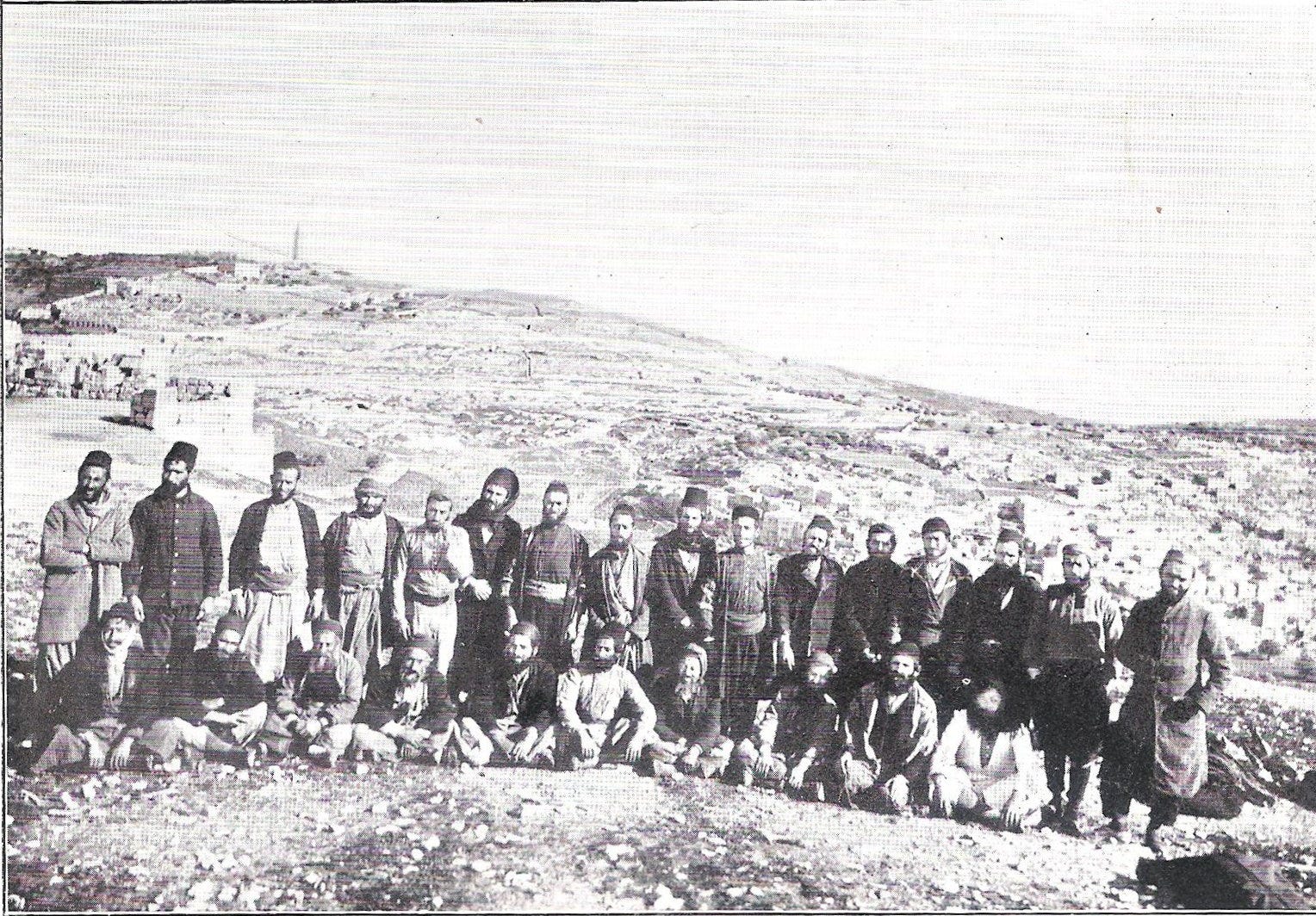
These were not European arrivals. They were Ottoman subjects with deep roots in the region, communities in Jerusalem, Safed, Tiberias, and Hebron that predated Zionist immigration by centuries, in some cases by millennia. Hillel Cohen’s Year Zero of the Arab-Israeli Conflict documents the Old Yishuv in detail: communities deeply embedded in Ottoman Palestinian life, with legal and cultural commonalities with their Arab neighbors that vastly exceeded anything they shared with the Eastern European arrivals of the First and Second Aliyot.
The new Zionist immigrants, predominantly from Russia, Romania, and the Austro-Hungarian Empire, were experienced by the Old Yishuv not as the first bearers of modernity. The Old Yishuv had its own exposure to modernizing currents: Alliance Israélite Universelle schools had operated in Jerusalem since 1870, missionary and European educational institutions were part of the broader Ottoman Palestinian environment, and the Tanzimat reform era had reshaped civic life across the empire. What made the Zionist arrivals alien was not modernity per se but a specific ideological program, secular nationalism combined with socialist labor organization, that was foreign to the existing community’s religious identity and Ottoman civic formation. As Anita Shapira documents, the Old Yishuv had “undergone slow processes of change” and included elements seeking modernization; it was the secular nationalist framing of the new immigrants, not modernization as such, that constituted the fracture line. Cohen documents the tensions between what the Old Yishuv called the “Moscovites” and the established population. The framing was not trivial disagreement. The secular Zionist immigrants rejected the religious culture of the Old Yishuv, operated on different economic principles, and brought an entirely different relationship to Ottoman authority. The colonial framing, which requires a unified colonizing group with shared interests and metropolitan backing, collapses on contact with this fracture line.
The Refugee Population and the Colonial Model
The colonial model requires colonizers to arrive from a position of security and power, as agents of expansion, extending metropolitan reach into new territory. This requirement is categorical, not scalar. The Eastern European Jewish immigrants of the First and Second Aliyot fail to meet it.
They were stateless or quasi-stateless refugees from the primary victims class of European civilization. The Russian May Laws of 1882 restricted where Jews could live within the Pale of Settlement, barred them from rural areas, and excluded them from most professions. The Kishinev pogrom of 1903 killed dozens and prompted mass flight. The wave of pogroms during the 1905 Russian Revolution killed hundreds and displaced tens of thousands more. In Romania and throughout the Habsburg periphery, systematic legal exclusion from economic life was the baseline condition of Jewish existence, not an exceptional circumstance.
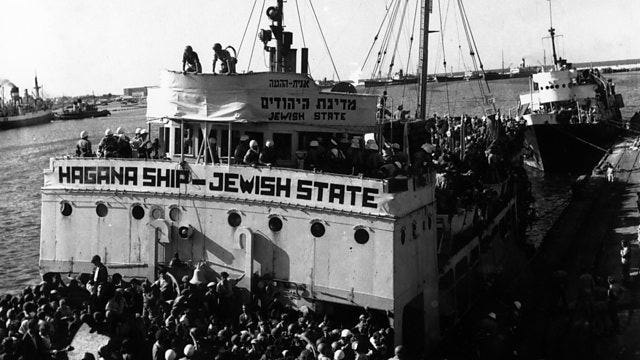
These immigrants were not agents of Russian or Austro-Hungarian imperial expansion. Russia and Austro-Hungary had no interest in Jewish settlement in Ottoman Palestine, in many cases they actively discouraged it. The immigrants came because they had nowhere else to go. Western countries had erected or were erecting barriers to Jewish immigration. The United States, the primary destination for most Eastern European Jewish emigrants, passed increasingly restrictive immigration legislation culminating in the 1924 Johnson-Reed Act, which used national origin quotas specifically calibrated to exclude Jews and Southern Europeans. The Zionist leadership chose Palestine as the destination for an ideological program of national reconstitution in the ancestral homeland. The immigrants chose it because the alternatives were limited and closing.
Arriving as a refugee from persecution is not the same thing as arriving as a colonizer extending metropolitan power. The framework requires the latter. The historical record shows the former.
The Historical Connection and What It Means
Jewish absence from majority status in Palestine was not a choice. It was the product of Roman imperial violence, the suppression of the Bar Kokhba revolt in 135 CE, the subsequent dispersal of the Jewish population from Judea, and the Roman renaming of the province as Syria Palaestina as a deliberate act of cultural erasure. What Zionism describes as “return” is not analogous to British settlers in Kenya or French settlers in Algeria, who had no historical presence to return to. It is something for which the settler colonial framework has no analytical category, because the framework was not built to describe it.
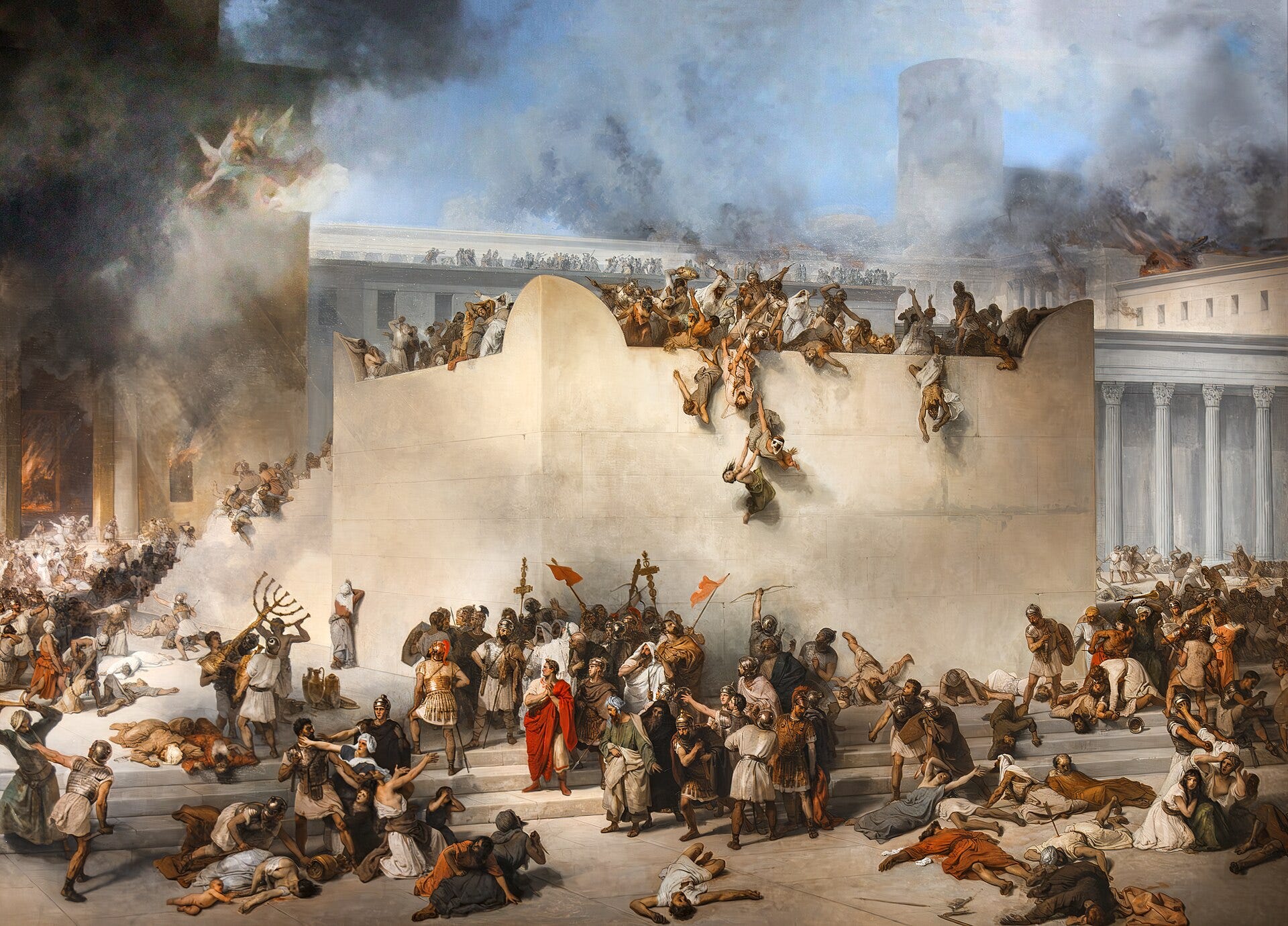
This does not resolve the claims of the people who were living in Palestine when Jewish immigrants arrived. Those claims are real, documented, and deserve serious analysis, which the remaining posts in this series provide. But it does mean that the specific framework being deployed to analyze those claims, built to describe overseas colonization by populations with no prior connection to the territory they occupied, is missing one of its central structural requirements from the outset. Derek Penslar’s formulation remains the right standard: “Placing Zionism within the broad sweep of Western colonialism leaves unexplained many of its key aspects, such as the nature of Zionism’s connection with historic Palestine.”
The Non-Static Demographic Picture
One further complication for the framework’s native/settler binary: the population of Palestine in the late Ottoman period was not static, and “native” cannot be resolved by pointing to whoever occupied the most recent layer before the one being contested.
Palestine under the Ottomans had seen significant population movements throughout the nineteenth century. Egyptian migrants arrived during and after Muhammad Ali’s occupation in the 1830s. Algerians displaced by French colonization found refuge in the Levant. Circassians were relocated from the Caucasus to the Levant after the Russo-Turkish wars of the 1870s as part of explicit Ottoman population policy, what Albert Hourani’s Minorities in the Arab World documents as settlement “for political purposes,” meaning the Ottoman state was using population transfer as an instrument of imperial administration in exactly this region at exactly this time.
The conceptual problem this creates for the framework is not that it invalidates Arab Palestinian claims, it does not. It is that the framework requires a clean native/settler binary that the actual demographic and administrative history of the region does not provide. Multiple populations with mixed origins and layered claims were present in the region, all of them shaped in various ways by Ottoman and European imperial processes they had not chosen and could not fully control. Reducing this complexity to a binary in which one population occupies the “native” slot and another occupies the “settler” slot requires imposing a theoretical template on a historical situation that resists it.
What the Decolonization Movement Itself Decided
There is a further dimension to the framework’s structural mismatch that is rarely acknowledged in contemporary applications: the international legal architecture of decolonization, constructed by the postcolonial nations most invested in dismantling European empire, explicitly excluded cases like this one from the definition of colony.
In the years following the UN’s founding, as former colonies gained membership and began using the General Assembly as a platform for promoting decolonization, the question of how to define “colony” for purposes of self-determination became politically urgent. The answer the decolonization movement itself arrived at is known among scholars as the Blue Water or Saltwater Thesis. The distinction it encodes was not a postwar invention. The conceptual separation between overseas colonial empire and contiguous land empire had been a recurring analytical judgment across the nineteenth and early twentieth centuries, made by imperial powers themselves: Russian historians and officials consistently distinguished Russian continental expansion from European overseas colonialism, and American debate over the Philippines after 1898 drew a sharp line between westward territorial integration under manifest destiny and the overseas possession of non-contiguous territories never expected to achieve statehood. What Resolution 1541 did was codify a distinction that already existed in the conceptual vocabulary of empire, giving it formal legal force within the international framework of self-determination. UN General Assembly Resolution 1541 (XV), adopted in December 1960, specified that non-self-governing territories are those that are “geographically separate and distinct ethnically and/or culturally from the country administering it”, meaning separated by open sea from the metropolitan power.
This definition was not a Western imposition designed to protect European interests. It was advanced by African and Asian nations, including leaders of the newly independent Congo, precisely because they needed a definition of colonialism that would protect their own newly independent states from internal separatism. If contiguous territories with distinct ethnic or cultural populations qualified as colonies entitled to self-determination, the same logic that could be used to demand Palestinian self-determination from an Israeli state could be used to demand Katangese self-determination from a Congolese state, and Belgium, which had just relinquished the Congo, was actively making exactly that argument. The Blue Water Thesis was the decolonization movement’s answer to that problem.
The practical consequence is significant. The settler colonial framework, as developed by Wolfe and Veracini in Western universities in the 1990s and 2000s, applies to Israel a category of analysis that the architects of formal international decolonization explicitly declined to apply to contiguous territories. The nations that built the legal infrastructure of decolonization drew the structural distinction that contemporary academic settler colonial theory collapses. That gap between the formal international framework produced by the decolonization movement itself and the contemporary academic framework is not incidental. It is evidence that the academic framework is doing different conceptual work than the legal framework, which returns us to Nirenberg’s question: what work is it doing, and why does Israel specifically require it?
The Modification Problem
Applying the settler colonial framework to a case where the arriving population has continuous historical ties to the land, arrived substantially as refugees from imperial persecution, encountered a co-ethnic community that was Ottoman rather than European in character, operated within a prior European imperial legal infrastructure it did not create, and was itself being manipulated by British imperial interests for purposes of its own, requires substantial modification and explicit argument, not assumption.
Aziz Rana’s recent piece in Dissent, the most careful contemporary defense of the framework’s application to Israel, acknowledges this by treating settler colonialism as a spectrum rather than a binary. This is an intellectually honest response to the historical complexity, but it is also a concession that the framework is being adapted rather than applied, that the case does not fit the framework as constructed, and that what is being argued is that a modified version of the framework still illuminates something useful. That is a different and weaker claim than the one usually made in public and political discourse, where the colonial label travels with its full prescriptive weight regardless of what modifications any individual careful user intends.
What the Ottoman and pre-Mandate historical record actually shows, when examined without the framework’s structural requirements imposed on it in advance, is something more complex than either the colonial indictment or the legal-purchase defense can accommodate: the collision of multiple partially displaced populations, each with legitimate grievances, layered historical claims, and deep internal divisions, inside a European imperial legal infrastructure that had been disrupting the region before either party arrived in significant numbers, and a British Mandate framework that was using all groups for its own ends while making incompatible promises to each.
That is not a comfortable picture. It is, however, an accurate one. And it is the picture the remaining essays in this series examine in detail.
The next post will examine the economic structure of the Yishuv and why the South Africa comparison, the most sophisticated version of the colonial analogy, fails on its own terms. The logic turns out to be precisely inverted.
Further Reading
On the Ottoman legal and demographic context:
Alexander Schölch, Palestine in Transformation, 1856-1882 (1993) — the foundational archival study of the pre-aliyah period. Schölch works from Ottoman administrative records, consular archives, and European commercial documents to reconstruct the land law, the musha’ system, and the economic transformation of Palestine before 1882. Indispensable for anyone engaging seriously with the land question.
Alan Dowty, Arabs and Jews in Ottoman Palestine (2008) — a careful documentary history of the early encounter period, including detailed analysis of land purchase patterns, absentee landlord structures, and the first generation of Arab-Jewish relations. Dowty’s data on the provenance of land sales is essential for understanding the fellahin dispossession mechanism.
On the Ottoman Jewish community:
Julia Phillips Cohen, Becoming Ottomans: Sephardi Jews and Imperial Citizenship in the Modern Era (2014) — the best study of how Sephardi Jews navigated the Tanzimat reforms and constructed a form of imperial citizenship from below. Essential for understanding why the pre-existing Jewish community was Ottoman in character rather than European.
Hillel Cohen, Year Zero of the Arab-Israeli Conflict: 1929 (2015) — focuses on 1929 as a pivotal moment but provides rich background on the Old Yishuv and its distinct relationship to Palestinian Arab neighbors, documenting the cultural and civic life of communities that predated and were structurally distinct from the Zionist settler project.
On Jewish-Arab relations in the late Ottoman period:
Louis Fishman, Jews and Palestinians in the Late Ottoman Era, 1908-1914 (2019) — Fishman draws on Ottoman archives and the Arabic and Hebrew press of the constitutional period to document how both communities were simultaneously constructing identities in relation to each other and to the Ottoman state. The most rigorous recent scholarship on the pre-Mandate encounter.
Neville Mandel, The Arabs and Zionism Before World War I (1976) — older but still valuable study of early Arab responses to Zionist settlement, based on Ottoman archival sources. Documents opposition emerging substantially from specific local concerns about land and labor rather than from a pre-formed nationalist ideology
On Zionism in its Ottoman context:
Derek Penslar, Zionism: An Emotional State (2023) — the most rigorous recent reassessment of Zionism as a historical phenomenon, attentive to what the colonial framing illuminates and what it distorts. Penslar’s formulation that the colonial framework “leaves unexplained many of its key aspects” is the scholarly standard the series works from.
Once again, great. Work. I'm also looking forward to the eventual further reading list. I've been working on a project on Ottoman Zionism recently and will be giving a poster presentation on it at a local conference. As I will probably have people asking questions about this, these articles, and your other work are incredibly insightful.